Pixels of the Week – March 22, 2026
Motion sickness game accessibility, meaningful UX research & dinosaur light art
Pixels of the Week is my weekly-ish curated newsletter for designers, UX folks, devs, and anyone building accessible, inclusive, usable (and let’s be honest, awesome) digital products. This edition focuses on accessibility in video games and motion sickness, durable design patterns for AI products and UX research insights on practical significance. Also: amazing apothecary-style products, fantasy art and dinosaur light painting.
Subscribe to my newsletter to get this directly in your mailbox!
Now: what I’m currently up to
My weeks are quite chaotic at the moment, so I have less time to read articles, test tools, I’m focusing on quality over quantity. I sadly also had to cancel my workshop on Product design, due to lack of participants. I’ll check if we try to run something another time. Or, maybe this specific workshop doesn’t have a target audience anymore, in current’s market. I honestly don’t know. I’ll try to investigate, when I get more time and bandwidth.
Video games accessibility: motion sickness and beyond
Motion sickness from games sucks If some video games make you sick (nausea, dizziness, off balance), first, hello, you are not alone. This is a sensory conflict, due to your body not moving while your eye sees a lot of movement. Kind of the same when you are car sick. It’s more common than you think.
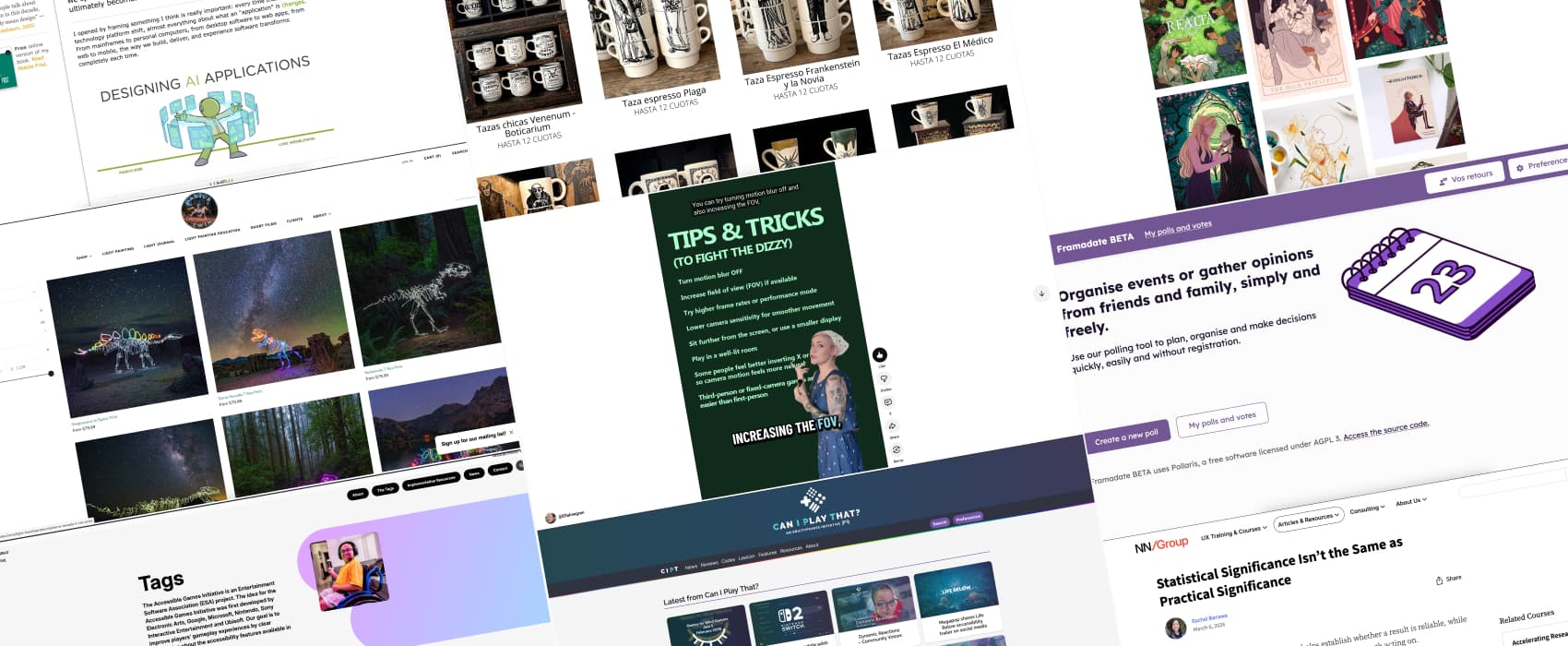
Second, Ellalowgren listed a lot of tips and tricks that could help you.
- Turn motion blur OFF
- Increase field of view (FOV) if available
- Try higher frame rates or performance mode
- Lower camera sensitivity for smoother movement
- Sit further from the screen, or use a smaller display (this is why I can play Borderlands on TV but not on computer, too close to the screen)
- Play in a well-lit room
- Some people feel better inverting X or Y axis, so camera motion feels more natural
- Third-person or fixed-camera games are often easier than first-person
Those tips and options rely on game developers, offering the options though. So, dear game developers, designers, first I love you and I know you are already doing an amazing and stressful job. But, also, please learn about how games can trigger sensory conflict, and offer us the options
And reach out if you are looking for some game testers with this type of issue, I’m happy to help make games less motion triggering for the rest of us.
Also, to learn more about accessibility and video games, check:
- Tags Accessible Games Initiative: an initiative to bring accessibility labels to video games
- Can I Play It, a blog that reviews different video games and lets you know their accessibility features:
- Game accessibility guidelines, a list of different settings and options games need to be accessible
Interesting articles that caught my attention
Durable Patterns in AI Product Design (8min) Luke Wroblewski describes how we went from products using AI models behind the scenes, to AI chatbots, products letting AI models make use of the tools, to finally products that connect AI systems together. He illustrates a couple UX patterns that become very important for AI products: suggestions, citations, multimodal responses, progressive disclosure of agent steps, explicit context controls, and AI led onboarding. I find this interesting, because, even with new tools / technologies, the human brain is the same. So concepts like progressively disclosing the information so that we don’t overwhelm the user, stays. The cognitive behavior and psychology knowledge we have, as UX researchers, still applies, just, in new ways, to new UIs, yeah!
Statistical Significance Isn’t the Same as Practical Significance (8min) Statistical significance tells you a result is real. Practical significance tells you if it is worth caring about. As UX researchers, we need both so we do not overreact to tiny effects or ignore big, noisy signals. This is why context matters. I have this exact case at the moment. A very small sample, but 90% of my users go towards one specific direction. Those users are representing their own business lines. Meaning, even if we only have a small sample, their direction makes indeed sense in the global business value.
What do coders do after AI? (10min) the sad truth of coders getting laid off, but also losing their identity in an economy where it’s cheaper to have AI produce 10 times the same code until it’s good enough, than having one developer write it the write maintainable way. by Anil Dash
Curiosity cabinet: non-design/tech rabbit holes I enjoyed
Manes Marzano Collection: a collection of products with a very 1800 London apothecary vibe. I love the stackable mugs that turn into a plague doctor and a skeleton
Inspiration: fun experiments, beautiful art, and great ideas
Rachel Eaton, also known by Rayleearts is an illustrator based in Michigan who specializes in fantasy. I love her style
Dinosaur Light Painting Prints Darren Pearson is a light painting artist from California, and I love his work, especially the series on dinosaur skeletons. No IA, no Photoshop, just talent and a lot of patience
Useful tools & resources
If you are looking for a free open source alternative to Doodle to organize polls, the new beta version of Framadate is honestly quite nice. Also, no need to create an account. And not horrible ads!!! They brought a lot of improvement, I’m very happy with it. (I still think the name is strange though haha, sounds like a dating app, sorry not sorry)
