Pixels of the Week – November 30, 2025
Anxiety toolkit, fun ninja cats portfolio & a cool color palettes tool
Pixels of the Week is my weekly-ish curated newsletter for designers, UX folks, devs, and anyone building accessible, inclusive, usable (and let’s be honest, awesome) digital products. This edition includes content on managing anxiety in tech, why accessibility boosts ecommerce, and the risks of AI erasing local knowledge. Also, a fun color palette generator, untranslatable words, and celestial physics fun.
Subscribe to my newsletter to get it directly in your mailbox!
Now: what I’m currently up to
I’m back from a pause, due to a couple of weeks of sick leave. I’ve been learning how to crochet in the meantime, it helps me relax. You can check out a couple of the amigurumis I made on Bluesky.
BlackFriday on the Shop -20%
Also, reminder: Black Friday savings for those of you who chose to support small businesses: get UX templates by yours truly with your 2025 budget and use them in 2026! Get 20% off everything in my shop with the code BF2025 before December 3 (and -30% if you subscribed to the newsletter with another coupon that you got in your emails).
Most popular content this week
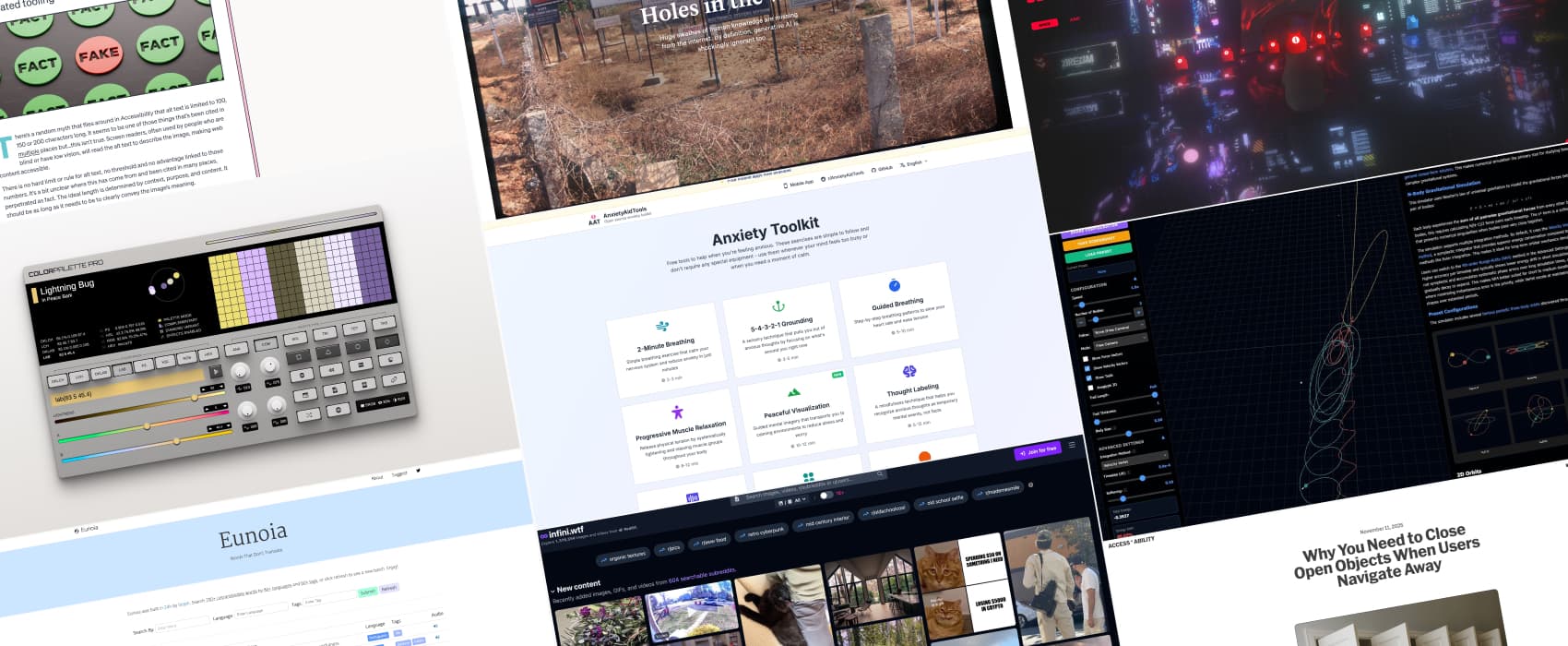
Anxiety Toolkit an open source collection of tools and exercises to help you manage your anxiety. And friends, do we need that with the current state of our industry. I really like the “5 things you can see, 4 you can touch, 3 you can hear, 2 you can smell, and 1 you can taste” one.
Interesting articles that caught my attention
Exposure (8min) A nice article by Hardik Pandya on how designers need to gain exposure from PMs, engineers, sales, users, researchers, to get out of an echo chamber. “Design + more design = pixel perfect but likely ineffective work. Design + broad exposure = effective work that lands”
Black Friday and Cyber Monday: why accessibility could be your biggest sales advantage (15min) Little reminder that an inaccessible website means lost customers, and lost revenues. “Research shows UK businesses collectively lose £17.1 billion a year because shoppers using assistive technology abandon websites that don’t work for them. During BFCM alone, that translates into nearly £446 million in lost revenue.” And, on the other side: disabled shoppers are loyal customers. And, yes, iin an ideal world we would make websites accessible because it’s the right thing to do, and it’s a universal right. But sometimes, reminding people about the business argument helps.
Holes in the web (23min) Huge parts of human knowledge are missing from the internet. By definition, generative AI is shockingly ignorant too. AI systems rely mostly on Western, English-dominant data, excluding oral, Indigenous, and low-resource languages. Deepak Varuvel Dennison illustrates this with an example of his father’s recovery using traditional medicine. And with examples of the strong connection between language and local ecological knowledge (often passed down using oral tradition) and how it leads to lost of knowledge about local plants, but also, local construction technics. AI ends up creating a feedback loop where dominant ideas are amplified while niche knowledge fades from view. I’ll leave you with a quote that resonated a lot with me: “The health of a system depends on the presence of all its parts, even those that might seem inconsequential. The same principle applies to human knowledge. The disappearance of local knowledge is not a trivial loss. It is a disruption to the larger web of understanding that sustains both human and ecological wellbeing.”
100, 150, or 200? Debunking the Alt text character limit (7min) “Alt text should be as long or short as it needs to be, just succinct and correct. Alt text is not about length. It’s about purpose and context, describing what an image shows and why it matters. Some images only need a few words, others deserve more detail.” Happy that this gets debunked by Chris Yoong because I’ve seen it again in yet another “white paper” (maybe written by AI, who knows?)
Curiosity cabinet: non-design/tech rabbit holes I enjoyed
Trisolation – N Body Simulator A little gem for physics and celestial mechanics enthusiasts that lets you explore how multiple objects move under gravity, using real physics equations. It visualizes complex orbital paths, like the famous three-body problem, and offers different methods to simulate long or short-term motion in space. Also, if you like books, there’s a sci-fi novel written by Liu Cixin on that topic: The Three-Body Problem, and a TV show.
Inspiration: fun experiments, beautiful art, and great ideas
Samsy Ninja (warning though: it plays sound and might trigger motion sickness and has flashing content) a fun portfolio with a cat that you can control with your keyboard
Useful tools & resources
infini.wtf explore images and videos from Reddit, at your own risk, but, you will be in for a ride for sure.
Color Palette: a fun color palette generator, that lets you play with different color spaces, and build different palettes type, with a look and feel that brings me back to some neumorphism nostalgia. by Ryan Feigenbaum
Eunoia there are certain words, in different languages, that are full concepts and can’t be translated. For example “Schadenfreude” in German. Eunoia lets you search 700+ untranslatable words by 80+ languages and 60+ tags. A fun rabbit hole for people who love languages.
3 free tools to caption videos with limitations and how to use them.
Tutorials
Why You Need to Close Open Objects When Users Navigate Away (5min) a short “how to reset ARIA states, close components and hand of focus cleanly” when users closes an element.
