Pixels of the Week – November 8, 2026
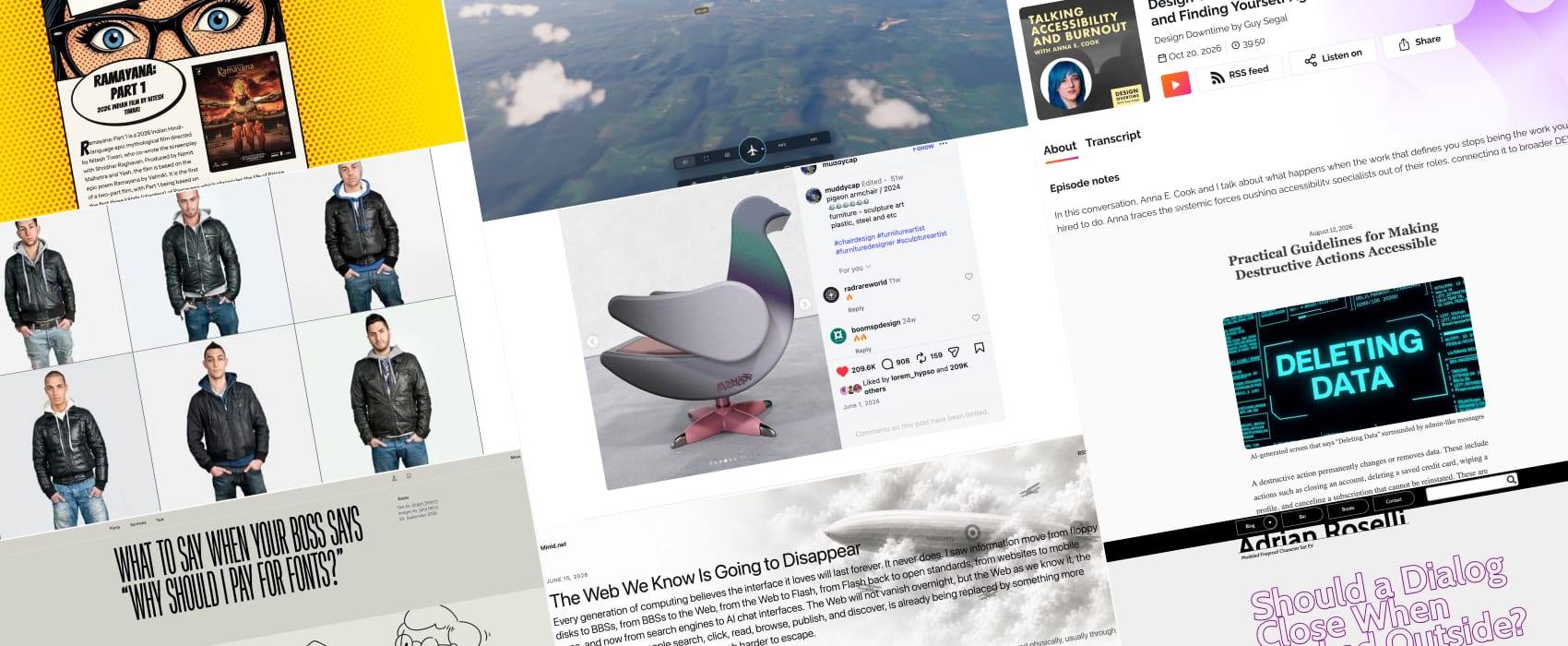
Could AI make the open web disappear, a fun pigeon armchair & portraits of people who dress alike.
Pixels of the Week is my weekly-ish curated newsletter for designers, UX folks, devs, and anyone building accessible, inclusive, usable (and let’s be honest, awesome) digital products. This week we explore if AI could make the open web disappear, if a dialog should close on outside click (plot twist: it depends), and we tag along flights in the sky. And don’t miss the fun pigeon armchair and portraits of people who dress alike.
Subscribe to my newsletter to get this directly in your mailbox!
I’ll be speaking about design & performance!
I’ll be speaking at performance.now() Amsterdam, 19th to 20th November 2026. My topic is about design and performance. Often we think that performance is the job of the developers. Working on super complex enterprise systems, that often load content and data from multiple systems, trust me when I say “yeah, performance is going to make or break your users’ experience, so, you need to do something about it.” And when I say you, I mean developers AND designers alike. I’ll bring examples from years of experience, real projects and explore what developers should expect from their designers for everything that happens before, during and after loading, and how to ask for it. Tickets are still available!
Articles
“Why should I pay for fonts?” “Perhaps your boss or the management team should assess and evaluate the cost of the investment in fonts in the same way they would invest in hardware and infrastructure.” Yup, this, and 9 pushbacks, and how to handle them.
The Web We Know Is Going to Disappear (15min) “The Web was built on a simple habit: click the link. AI breaks that habit. Not completely. Not immediately. But enough to change the economics of publishing.” Diego Martín Lafuente predicts websites will get used less and less by humans and become a place for machines to consume content. The website becomes a source, a dataset, not a destination anymore. The issue with that: we are building, again, a walled garden. And websites will become a nerd medium again. Sounds quite sad to me. And on kind of the same topic, but more positive: The Boring Internet (10min) by Terry Godier. For him, it’s not dying, but a commercial veneer glued on top of it is. The open internet of email, RSS, personal websites, and independent communities remains alive underneath.
Should a Dialog Close When Clicked Outside? (5min) If the action is required, for example age restriction on alcohol websites: no. If the action is not required and the dialog is informational: yes. For other cases, the answer is often “it depends” and you may want to ask yourself if the user might lose important data by mistake, if it would be difficult to restore it if they accidentally close, etc. I would test this with end users! By Adrian Roselli.
Curiosity cabinet
WikiPop! Answering the question: what Wikipedia page was everyone looking at? It’s an interesting proxy to see what the world was interested in for a certain date.
Inspiration
May I interest you in a pigeon armchair by muddycap?
Exactitudes: for the last 30 years, photographer Ari Versluis and profiler Ellie Uyttenbroek bring together portraits of people with similar clothes, hairstyles, and poses. The project shows that we are not as unique as we might think we are, and how style and the way we express it show the social groups we belong to. It’s also a nice time capsule showing how style evolved over the years.
Interesting websites
Stowaway: tag along real flights in the sky around you, and enjoy a rendering of what the view from this plane would be (based on real data).
Podcasts
Design Overtime: The Cost of Caring: Accessibility, Burnout, and Finding Yourself Again a super interesting podcast episode with Anna E. Cook about what happens when the work that defines you stops being the work you’re hired to do.
Tutorials
Practical Guidelines for Making Destructive Actions Accessible (8min) Some great advice on plain language copy and UX writing, focus management, button consistency, and having a way to escape the destructive dialog. The destructive item flows need to be tested with the same level of rigor as check-out flows!
