La Carte Blanche: A Project Definition Framework to Avoid Chaos
“What are the first questions you ask at the beginning of every project?” That’s what Dave Smyth asked me in an interview about my design process. I thought about it, and I noticed I often go back to the same questions, to help me get a clear project definition. If a client or team cannot define the project in a few simple ways, I already know it’s going to be a mess.
Those questions actually have a fun origin story. A few years ago, Laurence Vagner and I were asked to create some conference swag. The brief? “Vous avez carte blanche.” In French, you have total freedom. No direction, no constraints, nothing. Sounds like a dream, right? But in reality, full freedom is a trap for any project.
We decided to give them exactly what they wanted but with a small twist. We built a tool to help people clearly define projects upfront. Something small, practical, and easy to use. A card that gets people to ask the strategic right questions before the project even starts. And we called it “La Carte Blanche.”
The problem with poor project definition
One of the most common problems in design is starting without a clear project definition. Teams will waste a lot of time if they don’t agree on a shared vision for the project: who it’s for? Why does it exist? What are we trying to solve? Without this, designers go in all directions. Stakeholders change their minds. Scope creeps in. And at the end, no one is able to agree if the project was a success, because no one actually defined what success was supposed to look like.
The card tries to fix this.
What is “La Carte Blanche”?
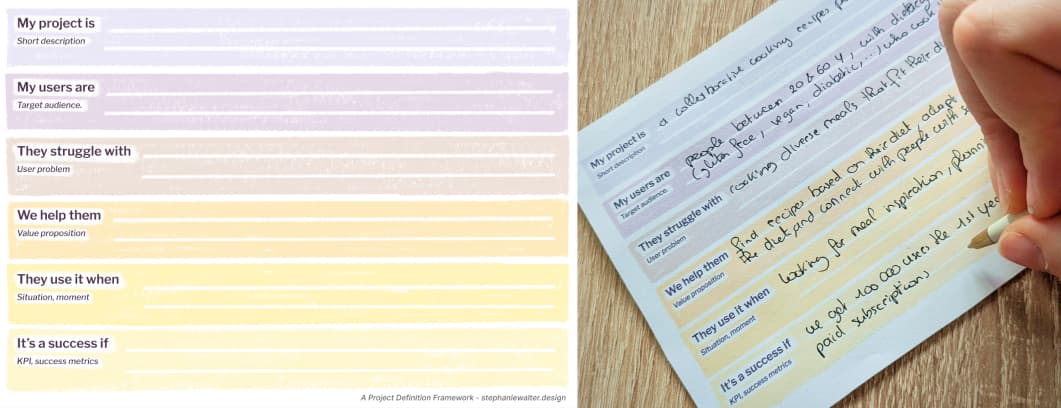
La Carte Blanche is a small A6 project definition card that you can print. Or fill directly as a PDF. This is based on sentence completion type of surveys. We give people 6 sentence starters, and they have to fill the blanks. Each one forces you, your client, and stakeholders to define specific aspects of your project.
- My project is: What is it? Describe it in one sentence.
- My users are: Who are they? Who is your target audience? If they answer “everyone, you know you have a problem.
- They struggle with: What is their problem? What pain is your project trying to solve?
- It helps them : What is the value proposition? What does your project allow them to do (that another tool, project, website didn’t)?
- They use it when: What is the context? When and in what situation will they use it? Sometimes it’s time related, sometimes situation, sometimes it’s a place.
- It’s a success if: What are our success metrics? KPI or observable change? How will we know this project is a success?
Six fields. One card. One clear definition.
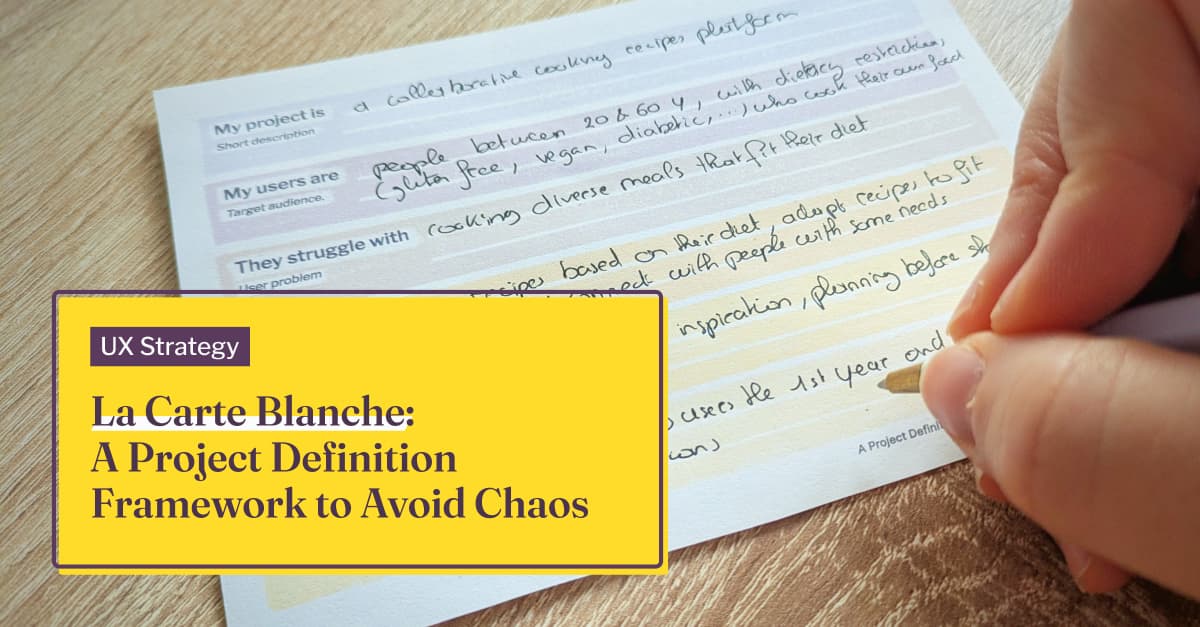
To give you a little example, once its filled it could look like this:
- My project is a collaborative cooking recipes platform
- My users are people between 25 and 60 years with dietary restrictions (gluten free, vegan, diabetic, etc.) who cook their own food
- They struggle with cooking diverse meals that fit within their specific dietary restrictions
- It helps them find recipes based on their diet, adapt recipes (swap ingredients) to their connect with people with same needs
- They use it when looking for inspiration, before planning meals
- It’s a success if we get 100 000 users the first year, with 30% of paid users
How to use my project definition framework
Option 1: Fill it with a client or stakeholder
If you are a designer or project manager working with a client, sit down together and fill the card. Go through each field out loud. The goal is not just to fill in the blanks. The goal is the conversation that happens while you do it.
Some fields will be easy. Others will spark a debate. That’s normal. That’s useful. The goal is to know early, where there are still undefined areas on the project.
Option 2: Run a small workshop
This works well with teams. Each person fills a card on their own, silently, in 5 to 10 minutes. Then you put all the cards on the table side by side.
If the answers match: nice, congrats, you are all aligned. If the answer differs: you have work to do to align people into a shared vision. You can for example use dot voting or a quick discussion to align and write one final shared card together.
Keep in mind: disagreement is not a failure. It’s actually a super valuable output of the exercise. It’s better to know earlier in the project that not everyone shares the same vision.
A few rules to keep in mind
It’s not a fixed artifact. The card captures the definition of the project at a specific moment. Preferable, before you start. But projects evolve, it’s fine. If the direction changes, update the card, with the new definition. And keep the old ones, to follow how your project evolved.
You can use one “I don’t know yet.” joker. If people are stuck, tell them they are allowed to leave one field blank and put “we don’t know yet” into it. Only one! Choosing which field to leave blank is actually also a big strategic decision. It tells you something important about where the gaps are. Is it the users you don’t know yet? The success metric? That’s worth knowing before you start, not three months in.
Use it as a reference point. Share the card with the team, put it on a wall, or in a folder everyone has access to. When scope creeps in, bring it out to hold everyone accountable. If you’ve moved so far from the original definition that the card no longer makes sense, maybe it’s time to re-assess your project. Did you pivot? Or did you just get lost?
It works for assumptions too. If you don’t know your users well yet, write your assumptions. Then run research. Check those assumptions against reality. Update the card when needed.
Who is this for?
This project definition card is for UX designers, UX researchers, and project managers who need clarity at the start of a project. It works for digital products, services, websites, apps, internal tools, and more.
It’s not a research deliverable. It’s a starting point. A shared definition that keeps teams aligned and helps everyone ask better questions.
Get the printable project definition card
This framework is free. Download it from my shop, print it at home, and use it for your next project. You’ll also get access to the next updates.
Get the Printable Project Definition Card
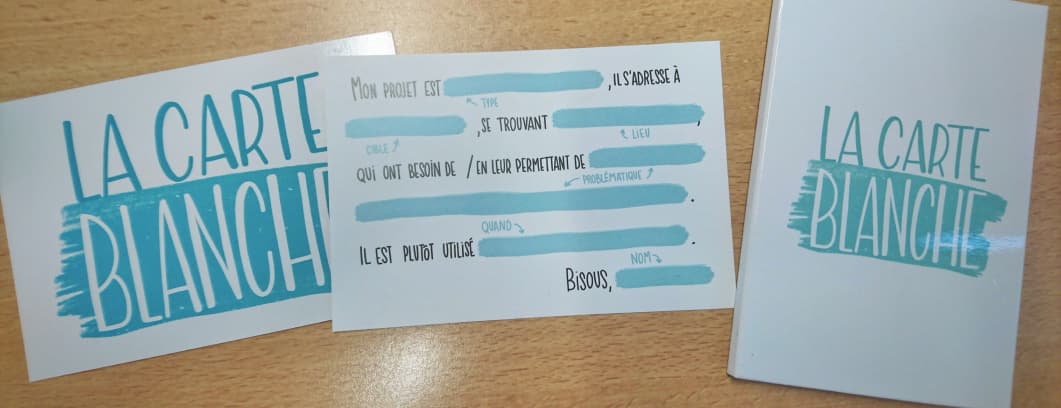
The original “Carte blanche” design
I found some pictures of the original artifact we created. It was in French and had fewer fields, but if you are curious, here was the first ever version looked like. Kudos again to Laurence for the design!!