Pixels of the Week – June 21, 2026
Time to think critically about AI, inaccessible systems and beautiful stained glass mirrors
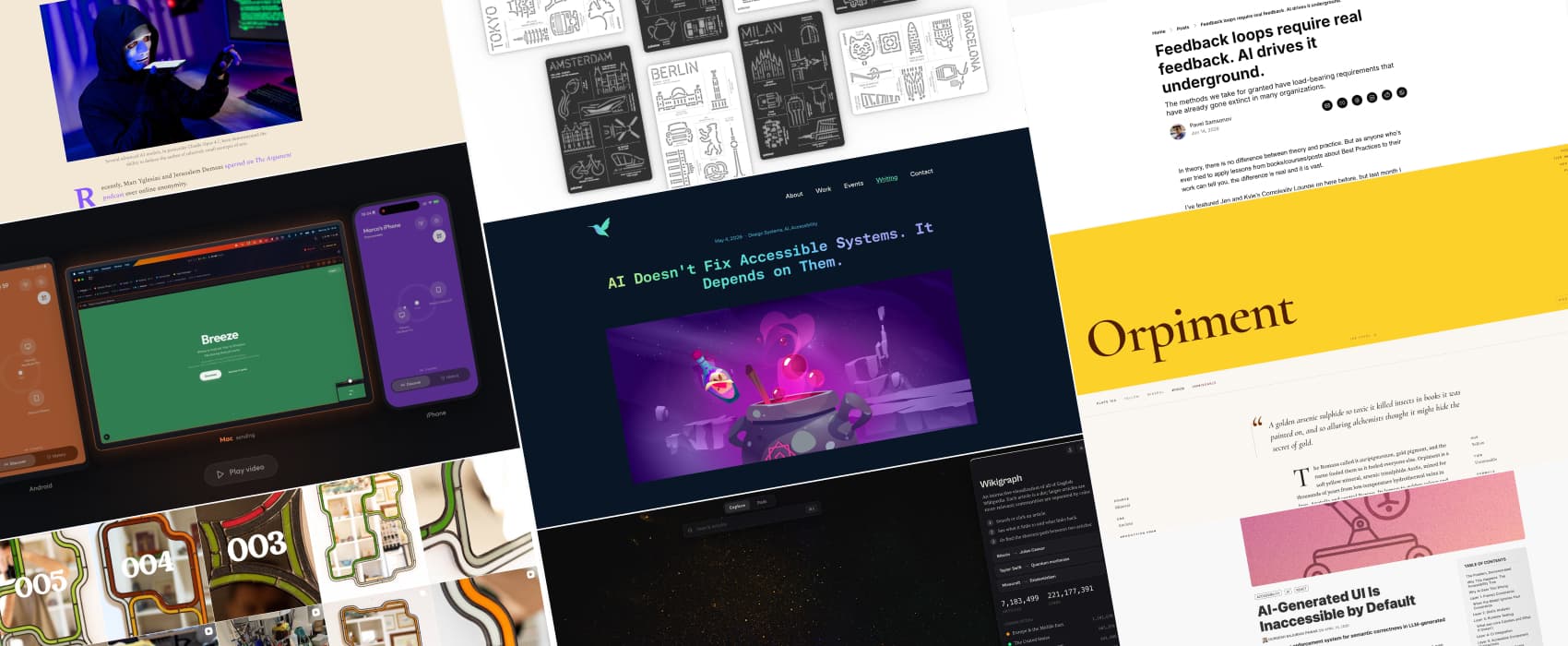
Pixels of the Week is my weekly-ish curated newsletter for designers, UX folks, devs, and anyone building accessible, inclusive, usable (and let’s be honest, awesome) digital products. This edition covers why inaccessible systems make AI worse, the theater of AI generated feedback, and dangers of ‘user-friendly’ AI. Also don’t miss a catalogue of 250 named colors, a Wikipedia link visualizer, and local file sharing tool.
Subscribe to my newsletter to get this directly in your mailbox!
Stickers!!
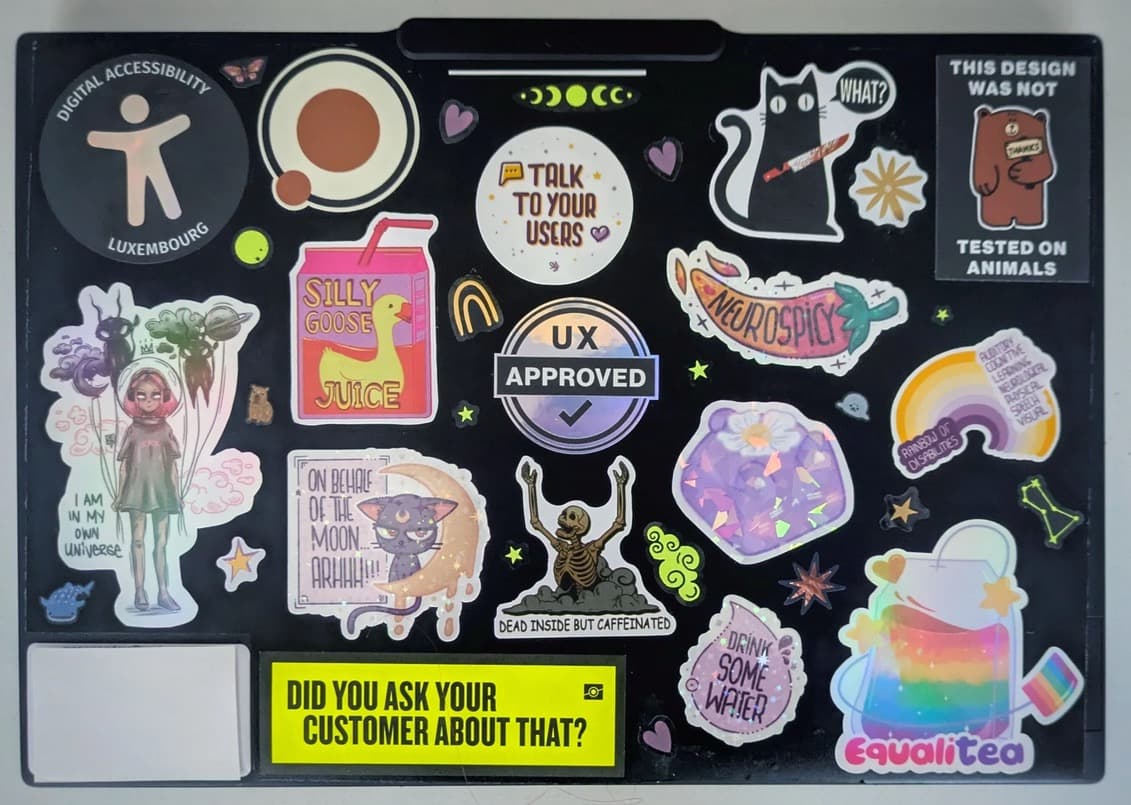
I changed my work laptop, so, it needed new stickers, obviously. This time instead of sticking them on it directly, I put them on some removable vinyl. This way, next time I change laptop, I can remove them all together, and apply the vinyl on the new one. Or just cut them one by and and keep them. Also, little reminder: I have a sticker shop. If you want to decorate your laptop with cute little beasts, accessibility and neurodivergent or UX design and research related stickers, here’s a -20% coupon for you, use it at checkout for any order with stickers, until July 21: HK8XCJSJ98
Some critical thinking about AI usage
Honestly it’s been hard to not read things about AI, but, I do hope you enjoy some perspectives that go beyond “let’s use AI for everything”
Feedback loops require real feedback. AI drives it underground. (12min) I have a love / hate relationship with Pavel Samsonov’s picnic articles: I nod while reading it and love it, but I also hate that he is, sadly, right about everything he describes. This edition is about how AI driven productivity theater breaks real feedback loops, with low quality design critique that often is based on myths the LLM has in their database. It gets worse in companies where employees are pushed to hide bad news and stay silent when products go into a wall. It’s not specific to AI, it existed before. But it just got, worst.
I can never talk to an AI anonymously again (15min) Kelsey Piper argues that, once you have a decent amount of writing on the internet linked to your name (for example, journalists), you have a recognizable “fingerprint”. She shows how, even when she tried to write anonymously, some recent AI models were able to “guess” who she was from her text. This is mostly an issue for journalists and anyone with a large corpus of their own content online, of course. But it also shows how anonymity is getting weaker by the day.
We built this. Now we own it.. The dark side of ‘user-friendly’ AI. (12min) In a culture that pushes hyper individualism, AI chatbots designed to feel like a friend exploit loneliness, blur reality, and can drive people to harm. A long, very interesting essay by Patrizia Bertini who urges designers to stop hiding behind “decisions are taken higher, we can’t do much” and start acting. She also lists concrete frameworks and tools like the NIST AI Risk Management Framework (nist.gov), EU AI Act (artificialintelligenceact.eu), OECD AI Principles (oecd.ai), etc.
AI Doesn’t Fix Accessible Systems. It Depends on Them. (15min) Anna E. Cook calls out the fantasy that AI or generative UI will save us where UX has “failed”. AI does not fix bad or inaccessible systems, it exposes and multiplies the issues that were already there. When the foundation is wrong, no layer on top can fully compensate. The way to make your website “AI ready” is still the same work we’ve been doing for years: robust hierarchy, semantics, and accessible design systems. To help us, she built a very useful framework you can get in Governing Accessible Design Systems in the AI Era.
Non AI related articles
When one Pixar employee accidentally deleted Toy Story 2 (10min) Having a bad day at work? Remember: an employee ran a command that almost wiped 90% of Toy Story 2, backups servers were down for a month. Then they saved the project because Technical director Galyn Susman was on maternity leave, working from home and was regularly syncing the film’s files to her personal laptop so she could keep work remotely . So, yeah, you should be fine.
Stop Forcing Focus and Give Your Desk a Neuroscience Glow-Up (10min) I like the idea of decluttering the desk, but I also like my dopamine decor (having many small cute objects that bring me joy), so I might need to find a balance. Also, yeahy for bringing plants (even fake ones). I know neurodivergent people struggle with transitions, so this idea of a focus activator also goes into that direction of giving your brain a cue, about the transition to “now let’s start working shall we?”. I need one, but it can’t be a cup of coffee because I drink it also when I don’t need to work (like when I craft, or simply browse). (by Nicole Byers, Ph.D.)
Beautiful objects
CityGrapher lets you draw the architectures and iconic symbols and landmarks of some cities (Paris, London, Berlin, Barcelona, Milan, etc.) using cute little stencils. Or course Paris has a baguette!
Glassy Fabio who is in the mood for some beautiful stained glass mirror? I am!
Interesting websites
Storied Colors is a catalogue of 250 named colors, from pigments, chemical formulas and dyes to a few digital hues, each tied to documented evidence for its name and history. You can browse all the colors, or simply check the color of the day.
Wikigraph is an interactive visualization of all of English Wikipedia and shows how articles are linked. It also helps you play the “find the shortest path between 2 articles game”. I’m a little bit disappointed it didn’t get the 09/11 to Fifty Shades of Grey pipeline right though. (and in case you don’t have this pop culture reference, there’s a butterfly effect explained on reddit)
Useful tools & resources
Breeze I’m testing this tool to easily exchange files between my Android phone and my macbook, and it’s been quite nice so far. Also, it uses a local network. No login. Also, super fast. I like the “We do not sell data. There is nothing to sell.” promise hehe.
Tutorials
AI-Generated UI Is Inaccessible by Default (13min) a couple of reasons why AI generated code is inaccessible by default (I never thought about the token economy and how inaccessible code consume fewer tokens, interesting), and how to improve that, with prompt constraints, static analytics, runtime testing, CI integration, accessible component abstractions. By Durgesh Rajubhai Pawar
