Pixels of the Week – September 6, 2026
Accessibility ownership, enterprise UX patterns for AI and whimsical cat illustrations.
Pixels of the Week is my weekly-ish curated newsletter for designers, UX folks, devs, and anyone building accessible, inclusive, usable (and let’s be honest, awesome) digital products. This week we cover accessibility ownership from design to development and why enterprise UX patterns matter for AI and power users. Also, an interesting IKEA complexity index, tech ad archive, whimsical cat art, and a nine-tailed fox book.
Subscribe to my newsletter to get this directly in your mailbox!
Now: what I’m currently up to
I’m currently all over the place, updating my Accessibility for Designers workshop, so this edition will be super short. Between client work and the workshop, I don’t have much time left days to read articles, test tools, etc. Things should hopefully calm down in October. Still, I finished a crochet Vulpix, because, why not. (I won’t tell how long this took haha). And, I sold a couple of stickers this week, yeaah!
Articles
Accessibility getting dropped in the process (12min) Developers can say “this can be implemented accessibly,” after checking the design, and we might still end up shipping a feature with missing alt text and broken focus in the final product. Nic Steenhout argues the real problem isn’t a lack of accessibility knowledge, but ownership that never gets carried forward between design, dev, and QA. What needs to change? We need to find ways to carry forward the accessibility requirements at each stage: write accessibility into acceptance criteria, shared component libraries, and checkpoints throughout the process, not just a final audit.
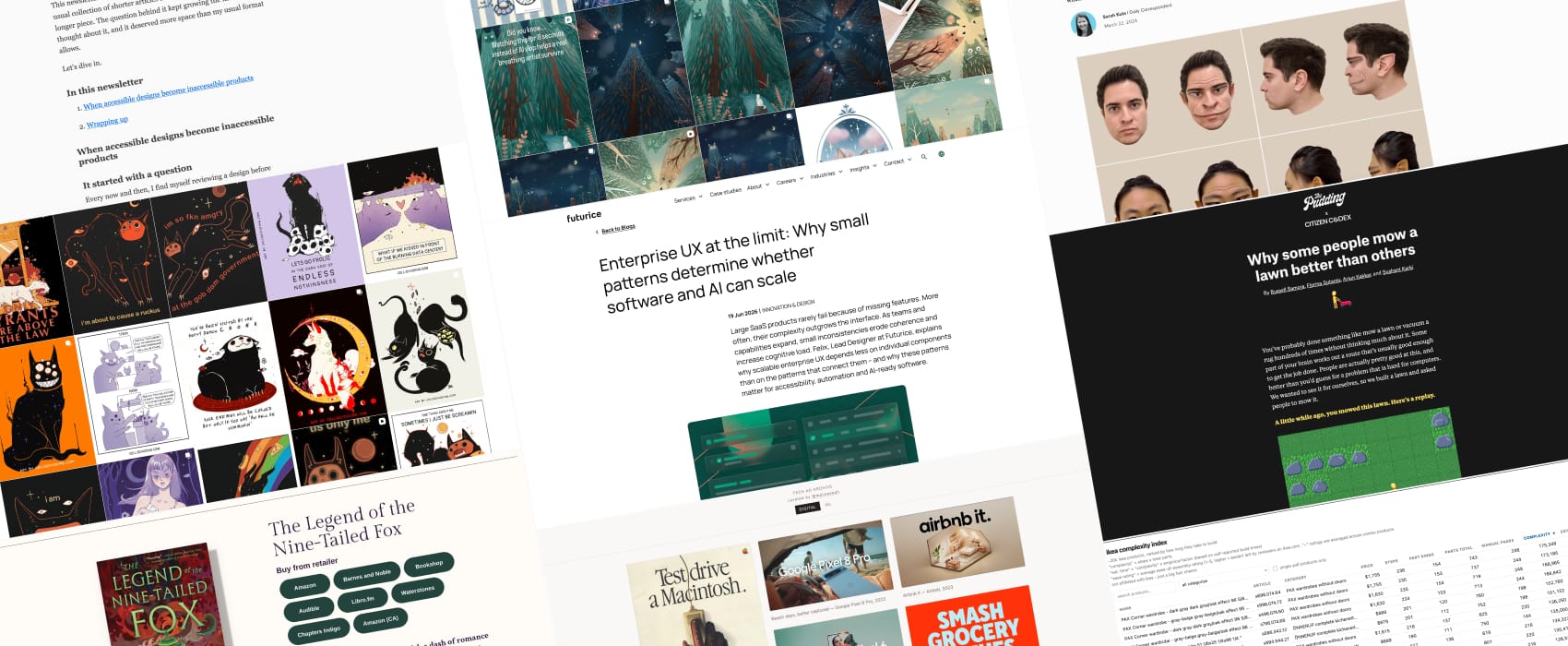
Enterprise UX at the limit: Why small patterns determine whether software and AI can scale (12min) Defining and documenting patterns, implementation constraints (anything that will make interactions predictable) is the key to consistency in enterprise products. Especially for highly re-used patterns: navigation, filters, data-heavy views, etc. The pattern documentation must be both human and machine-readable. Documentation is not enough: we need advocacy, clean ownership and a strong governance to enforce those rules. Felix Hohl also argues that standardized behavior and predictability will help agentic AI and accessibility. I can’t disagree here, even though it’s quite problematic that we now bundle AIs and disable people’s needs together.
Last but not least, I love this part: “Enterprise power users often need to see hundreds of data points at once. Forcing a “clean” look can break a professional’s workflow. The goal is not the prettiest solution. It is the most functional one.”. No notes, can we print it and put it in the office please?
This Extremely Rare Neurological Condition Makes Faces Appear Distorted or ‘Like a Demon’ (10min) the human brain is a marvel, and for the first time, scientists have recreated what one patient suffering from prosopometamorphopsia, or PMO, sees when he looks at faces.
Curiosity cabinet
In this week’s “I have no idea why this exists, but actually who cares, it’s fun that is exists”, let me present to you, ikea complexity index a website that ranks ikea products based on long they take to build. Actually, no, I do see why this could exist: people with low energy, who hesitate between 2 products and want to see which one will be the easiest to build for them.
Inspiration
Anahit – @jedessineleschats is a French illustrator who draws cats. I really love the magic and whimsical forest ones. Bonus point: you can get them as animated wallpapers for your phone on her Etsy.
And to stay on the topic of cats, you might also enjoy Jennifer O’Toole’s work. The vibe is more witchy and demonic, and I really love how uncanny and clumsy some of those cats look especially the black with an orange face and 3 eyes and silly little sub-text on her instagram.
Tech Ad Archive a collection or digital and IRL iconic tech advertisements for your inspiration.
Interesting websites
Why some people mow a lawn better than others: a fun experiment and an interactive dataviz, where The Pudding tested over 30 000 people on a virtual mowing game. The conclusion: finding the optimal path is not about thinking longer, but at the right moment. Planning complex sections while mowing the simple ones is the key.
Books
I finished The Legend of the Nine-Tailed Fox, it was quite nice. If you like found family, enemies to lover and some Chinese mythology, you should enjoy that one! Trigger warning: some description of body parts getting eating by the Fox, because, a lady has to eat.
